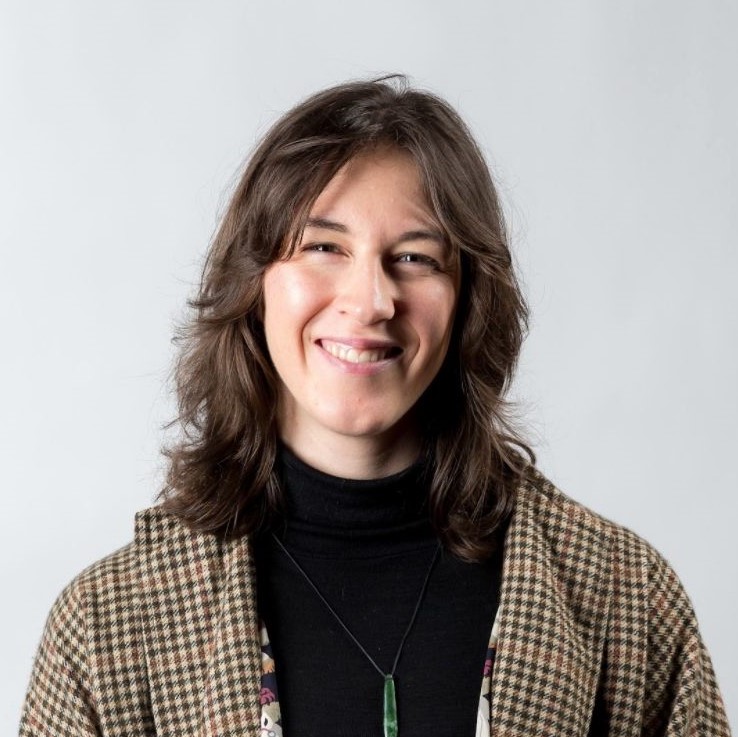
Charlotte Milne
PhD Candidate
Research Affiliate- Natural Resources Canada
Canada Graduate Research Scholar
PICS Uplifting Reciprocal Research Scholar
UBC Public Scholar
Young Scientist Award Recipient- Integrated Disaster Risk Management Society
Disaster Resilience Research Network Fellow (2022-2024)
Contact Details
https://www.linkedin.com/in/charlotte-milne/
cmil137[at]mail[dot]ubc[dot]ca
Research Interests
Disaster risk reduction, Flood management, Disaster decolonization, Flood mapping, Participatory methods
Bio
Charlotte is a flood risk researcher and IRES PhD Candidate. With an MSc in fluvial geomorphology and now seven years of experience in the social sciences, Charlotte is passionate about the intersection of technical disaster sciences and community risk reduction.
In her doctoral research Charlotte works with federal government and B.C. community partners to examine Canada’s flood mapping system and how it can be improved to help reduce risk for all. In her first chapter, Charlotte used mixed methods to engage technical mapping experts from across Western Canada to assess what steps are required to improve flood hazard maps. In her second chapter, Charlotte is undertaking a policy review, examining whether the information from regulatory flood maps is being effectively incorporated into risk-reducing action. In her third chapter, Charlotte explores the need for decolonial flood mapping practice in Canada and is undertaking a case study review of how First Nations across the country are being engaged in flood mapping. Finally, Charlotte works with Sema:th (Sumas First Nation) on the ongoing flood management decisions being made in the Abbotsford area following the 2021 B.C. floods. In her final chapter Charlotte co-designed a participatory mapping method with Sema:th to assess how their values aligned with proposed flood changes in their territory. Charlotte is supervised by Professor Stephanie Chang (IRES & SCARP) and Professor Simon Donner (IRES & Geography).
Alongside her PhD research Charlotte is a Research Assistant with the Living With Water research project and held a Research Fellow role with the UBC Disaster Resilience Research Network from 2022-2024. Charlotte is from Aotearoa (NZ) and holds Te Rarawa (Māori iwi/tribe) and Pākehā (European) whakapapa (ancestry).
Featured Publications:
Milne, C. (2025). The ability to map floods has never been better… so why is flood damage still growing? Pacific Institute for Climate Solutions Reflection Series. Available from: https://climatesolutions.ca/reflections/the-ability-to-map-floods-has-never-been-better-so-why-is-flood-damage-still-growing/?utm_source=linkedin&utm_medium=social&utm_campaign=hootsuite
Milne, C. (2025). Overuse of riprap to prevent riverbank erosion is harming B.C. rivers. The Conversation. Available from: https://theconversation.com/overuse-of-riprap-to-prevent-riverbank-erosion-is-harming-b-c-rivers-255283
Klemm, M., Milne, C., Brown, I., Ringham, S., Nelson, W. (In Publication, Accepted Oct 2025). Tracing taonga trajectories: a methodological framework for Indigenous heritage mapping. Journal of the Royal Society of New Zealand.
Milne, C., & Crawford, E. (2025). Best Practices in Western Canadian Flood Mapping: Findings of the WFMC expert workshop. Prepared for Natural Resources Canada. Available from: https://climatesolutions.ca/resources/pics-library/?post_tag=sea-level-rise-flooding
Milne, C., Legere, T., Eaton, J., Shneiderman, S., Molina Hutt, C. (2024). The state of disaster and resilience literature in British Columbia, Canada. A systematic scoping review. International Journal of Disaster Risk Reduction, 113 (104848), 2212-4209. https://doi.org/10.1016/j.ijdrr.2024.104848.
Lueck, V., Milne, C., Huynh, T., Watterodt, F., Rees, A. (2024). Flood Governance Mapping Report: Participatory timeline mapping guide. Prepared for Ministry of Water, Land and Resource Stewardship by Living With Water. Available from: https://www.researchgate.net/publication/390980194_Flood_governance_mapping_report_Participatory_timeline_mapping_guide